Bonus abuse in a 24-location chain: over UAH 200,000 in 90 days
A guest’s purchase could look completely ordinary: they received their order and paid for it. However, the bonuses for that purchase went to an employee’s card. Those accumulated bonuses were later used to pocket part of other guests’ cash payments.
A representative of one Loyallyst client, a chain of 24 locations, described this scheme. Below, we examine how the abuse worked and its scale, based on the information the client provided.
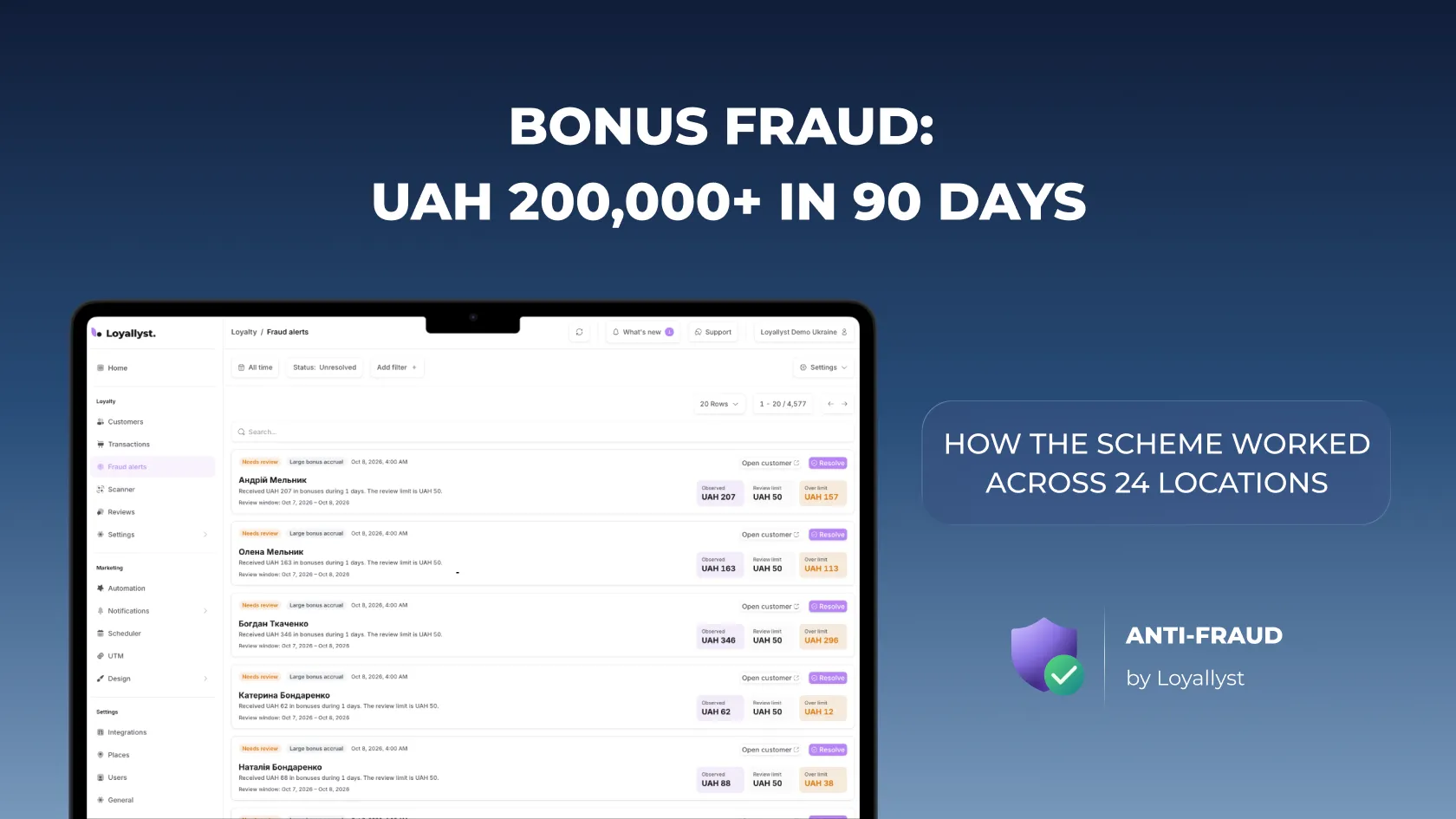
The scale over 90 days
| Metric | Client’s data |
|---|---|
| Chain size | 24 locations |
| Period covered by the reported amount | 90 days |
| Bonuses accumulated on cards within the scheme | Over UAH 200,000 across the chain |
| Subsequent use | According to the client, most were converted into cash through redemption |
Over UAH 200,000 is the total across all 24 locations for the stated 90 days.
How bonuses from guests’ purchases reached employees
The cashier asked a guest whether they had a bonus card. If the guest said no, the employee attached their own card to the receipt.
The guest paid for the purchase, but the cashier received the bonuses. After further purchases of this kind, the balance grew. The card history could suggest that its owner frequently bought from the chain, even though different people were spending the money.
These records also distort customer analytics: the business sees one active buyer instead of many guests. Unusually frequent purchases on a card should therefore be checked against receipts.
How accumulated bonuses were converted into cash
The next stage occurred during purchases by guests who had no loyalty card and paid in cash.
The guest handed over the full purchase amount. The cashier redeemed bonuses from their own card to cover part or all of the receipt. They kept the same amount from the cash they had received.
According to the client, employees acted differently. Some covered the entire purchase with bonuses. Others redeemed small amounts to attract less attention.
If you look only for large redemptions, small ones may go unnoticed. Also check the total over a period: how many bonuses were credited to the card and how many were spent from it.
What this pace would mean over a year
Over UAH 200,000 in 90 days means potentially over UAH 800,000 in accruals per year, if the scheme continued at the same intensity.
Calculation: 200,000 ÷ 90 × 365 ≈ UAH 811,000, or, rounded, more than UAH 800,000 per year.
This is a calculation, not an actual annual result or a confirmed annual loss. According to the client, most of the accumulated bonuses were converted into cash; the exact amount taken was not stated.
Which checks help identify similar activity
When reviewing similar cases, focus on three things:
- Purchase frequency on a card. Many transactions may result from different guests’ purchases being recorded on one card.
- Accruals and subsequent redemptions. Check both stages: where the balance came from and which purchases it paid for.
- The total over a period. Small redemptions can add up to a significant amount when repeated regularly.
For a chain, also examine locations and staff shifts. Compare high redemption volumes with the venue’s sales, card histories, and POS operations. A large amount alone is not proof of abuse.
How to apply this experience to your bonus program
Loyallyst antifraud alerts help select cases involving four types of activity: frequent purchases, high accruals, high redemptions, and purchases close together in time. The business sets the thresholds, and completed transactions are checked once a day. You can also check data for the previous three months.
After receiving an alert, the administrator opens the card history and compares suspicious purchases with POS data.
We explain how to choose thresholds, account for normal guest behavior, and review an alert in our article about protecting a bonus program and Loyallyst antifraud alerts.
Separately, check how the cashier attaches a card to a receipt. If the POS settings allow it, use scanning instead of entering a phone number or manually selecting a guest. An employee can still present their own code, but the action is easier to verify using a camera pointed at the scanner. This is a recommendation for venues facing a similar risk; there is no information on whether it was implemented in the chain described.
Discuss with the Loyallyst team how to configure bonus program monitoring for your locations and working procedures.
Let’s talk
Leave your contact details, and we’ll get in touch shortly.

Frequently asked questions
The case describes one Loyallyst client, a chain of 24 locations. The scale and mechanism of the abuse are based on information provided by the client’s representative.
It is the total bonuses accumulated within the described scheme across all 24 locations over 90 days. According to the client, most were converted into cash, but the exact amount taken was not stated.
No. This estimates potential annual accruals if the same pace continued: 200,000 ÷ 90 × 365 ≈ UAH 811,000. It is not an actual annual result or a confirmed loss.
Repeated small redemptions can add up to a significant total. Review the whole period and compare accruals and redemptions against the card history and receipts.
There is no information on implementation. Scanning instead of manual number entry is a recommendation for venues with similar risks, where supported by the POS system. Employees can still scan their own code, but that action is easier to check on video.