How to Attract Customers to Your Business: Practical Approaches That Actually Work
To be honest, almost every business owner eventually asks the same question: how to get customers without wasting the budget. There is advertising, social media is active, promotions are launched — yet the flow grows and then drops again. And this is where things get interesting. Because attracting customers is not a single button. It’s a combination of actions that work together. And if you structure them correctly, you can not only “catch” a customer once but turn them into a regular. Let’s break it down step by step — what really works and where money is most often lost.
Where does customer acquisition actually begin?
Many people think that the answer to how to quickly get customers is advertising. Launch ads, offer a discount, get traffic. Yes, it works. But not for long. If simplified, the process looks like this:
| Stage | What happens | Where the problem usually is |
|---|---|---|
| Acquisition | people discover you | expensive traffic |
| First visit | customer tries the product | no reason to return |
| Retention | customer comes back | no retention system |
And it’s at the third stage that most businesses fall apart. Customers come… and disappear.
Why is advertising alone not enough?
Let’s say you own a café and are thinking about how to attract new customers. You launch Instagram ads — 200 people come. Sounds good. But then:
- 120 people never return
- 60 come back once
- 20 become regulars

What actually helps attract customers?
There are several approaches that consistently work. But the key point — not separately, but together.
1. Entry point (first contact)
This can be:
- advertising
- signage and foot traffic
- recommendations
- social media
2. Reason to return
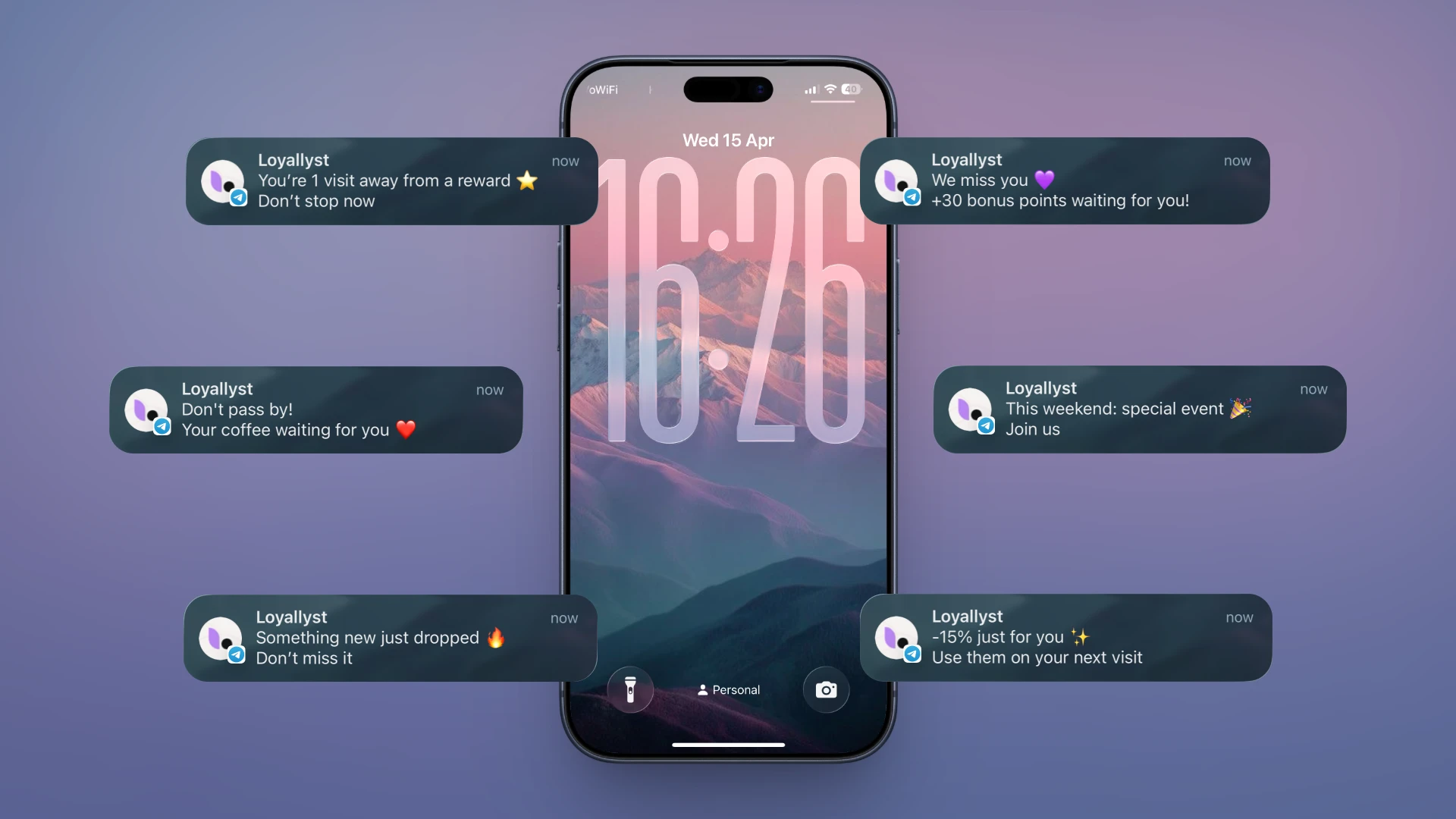
This is where many businesses lose customers. Imagine the situation: A person visits a bar and likes everything. But a week later, they choose another place. Simply because nothing holds them. Now another scenario: After the visit, they receive:
- bonuses for the next order
- a notification about an event
- a personalized offer
Where does a loyalty program appear?
In essence, a loyalty program is not “a discount for the sake of a discount”. It is a tool that closes the gap between the first visit and the repeat one. And this is exactly where it begins to influence acquisition. Paradoxically, but true: loyalty helps attract more customers no worse than advertising. Why? Because:
- customers come back on their own
- recommend you to others
- bring their friends
Business examples
To avoid being abstract — let’s look at real scenarios.
Case 1. Café and average check growth
A bonus system for a café is implemented: 5% is returned as points. What happens:
- the customer places an order for $10
- receives $0.5 in bonuses
- comes back to “use” them
- repeat visits +28%
- the average check increased to $11.5
Case 2. Beauty salon and bookings without advertising
Question: how can specialists attract clients if advertising is expensive?
A simple loyalty system for a beauty salon is introduced:
- a bonus for each visit
- an additional bonus for every 5 visits
- customer return rate increased by 35%
- bookings are filled without additional advertising
Case 3. Clothing store and “stagnant inventory”
Problem: the new collection is not selling.
Solution using a loyalty program for a clothing store:
- push notifications with a bonus for a specific category
- additional discount for regular customers
- sales increased by 18% in 2 weeks
- some customers came specifically for the bonus

How does acquisition through loyalty actually work?
If simplified, the logic is:
- A person visits for the first time
- Receives a bonus or a card
- The thought appears: “I’ll come back”
- Returns sooner
- Forms a habit
What does a loyalty card provide?
It’s worth highlighting loyalty cards separately. A digital card is not just a bonus account — it’s a point of contact with the customer. With it, you can:
- send push notifications
- remind about yourself
- offer personalized deals
- bring back “lost” customers
Comparison of approaches
| Method | Quick result | Long-term effect | Cost |
|---|---|---|---|
| Advertising | yes | no | high |
| Promotions | yes | partially | medium |
| Loyalty program | not immediate | yes | pays off |
Where do businesses most often make mistakes?
There are several common mistakes:
- offering discounts without a system
- not working with the customer base
- not segmenting the audience
- forgetting about customer retention
Conclusion
In short: acquisition is not only about new people. Yes, it’s important to understand how to attract customers to a store or salon. But it’s even more important not to lose those who have already come. And this is where a loyalty program plays a key role:
- increases return visits
- raises the average check
- reduces dependence on advertising



Frequently Asked Questions
Advertising brings traffic, but without a retention system most customers disappear after the first visit. You pay for each new customer over and over again instead of working with those who have already been.
A loyalty program closes the gap between the first and repeat visit: the customer gets a bonus, has a reason to return, gets into the habit, and starts recommending you to others — this is attraction without additional advertising costs.
Salons, shops, and cafes successfully fill bookings and grow traffic through their own customer base: visit bonuses, push notifications, and personal offers work better than expensive targeted ads.
A digital card is a permanent point of contact with the customer on their phone. It allows you to send reminders, personal offers, and bring back those who have not visited in a long time — without a separate app.
A loyalty program does not deliver instant results like advertising, but it pays off in the long run: it increases customer retention, raises the average order value, and reduces dependence on constant advertising spend.