How HookahPlace Metropole Uses AI in Loyallyst to Work with Guests
After implementing the loyalty program, we started using AI tools in Loyallyst to analyze our customer base and prepare marketing activities. Previously, finding patterns required manually exporting reports, comparing metrics, and spending several hours on analysis. Now, many tasks can be completed in just a few minutes with a simple AI request. Based on our experience, this saves the marketer and manager from 5 to 10 hours of work per month — time that used to be spent preparing segments, finding insights, and analyzing campaign performance.
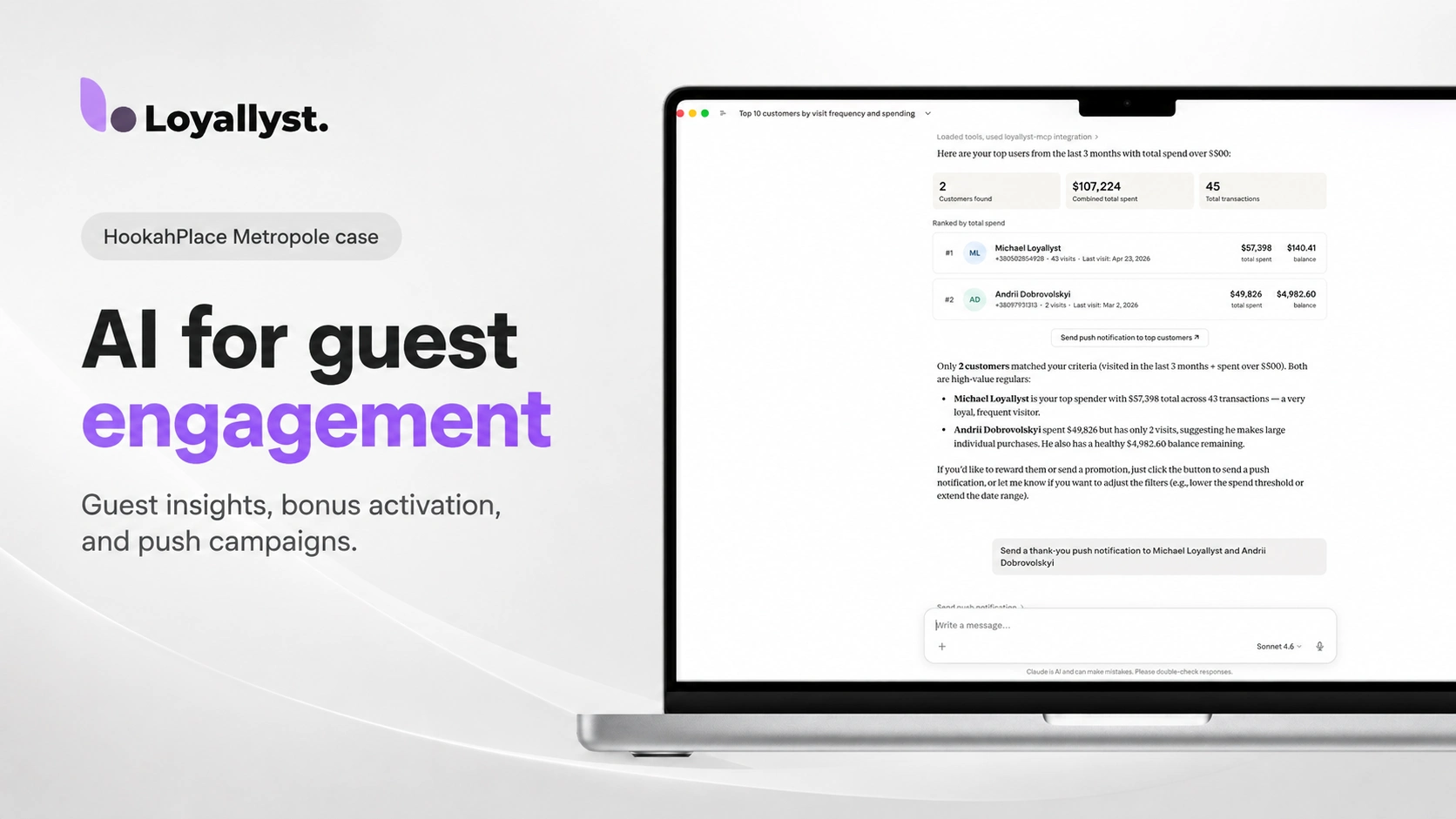
Case #1. Finding Guests Who Stopped Coming Back
One of the recent requests that can be sent to AI: “Show guests who used to visit the venue at least twice a month but haven’t visited us in the last 45 days.” In just a few seconds, AI analyzes the customer base and shows:
- how many guests are currently in the risk zone;
- how much revenue they used to generate;
- how long it has been since they stopped visiting;
- what potential revenue can be recovered.
Case #2. Finding Guests with Unused Bonuses
Since HookahPlace Metropole actively uses a bonus system, another scenario is especially useful for us. We can ask: “Show guests who have accumulated more than 3,000 bonuses but haven’t used them in the last 30 days.” AI immediately shows the segment size, the total amount of accumulated bonuses, and the potential revenue that can be recovered by activating these guests. After that, the system suggests a ready-made mechanic: “Remind guests about their bonuses and give them an additional bonus on their next visit.” If needed, AI instantly creates the message text and launches the campaign for the selected segment. This helps not only analyze data, but turn it into specific actions in just a few minutes.
Case #3. Fully Automated Campaigns
Another scenario we use regularly: “Suggest a campaign for guests who haven’t visited the venue for more than 30 days.” AI suggests the mechanic, prepares several text options, and shows the expected effect of the campaign. But the most interesting part is that after this, you can ask: “Create a marketing plan for the upcoming week for all main guest segments.” AI will automatically prepare a communication calendar:
- Monday — remind guests about their accumulated bonuses;
- Wednesday — send an offer to guests who haven’t visited the venue for a long time;
- Friday — communication for regular guests;
- Sunday — a campaign to increase repeat visits.

What Changed After Implementation
The greatest value of AI for us is not text generation, but the ability to make data-based decisions faster. Previously, finding answers took hours. Now, many questions can be asked in plain language and answered with ready-made analysis in just a few minutes. According to our estimates:
- save up to 5–10 hours of the team’s work every month;
- launch marketing campaigns faster;
- reduce the amount of manual work with reports and segmentation;
- make more decisions based on data rather than intuition.

Frequently asked questions
According to HookahPlace Metropole, AI saves marketers and managers from 5 to 10 hours per month by automating segmentation, customer database analysis, and campaign text preparation.
No. All requests can be written in plain language — for example, “show guests who haven’t visited the venue for more than 45 days”. AI analyzes the data, suggests scenarios, and launches the campaign without switching to the admin panel.
The most useful scenarios include finding guests at risk of churn, activating customers with unused bonuses, and automatically planning a marketing calendar for the week ahead.